


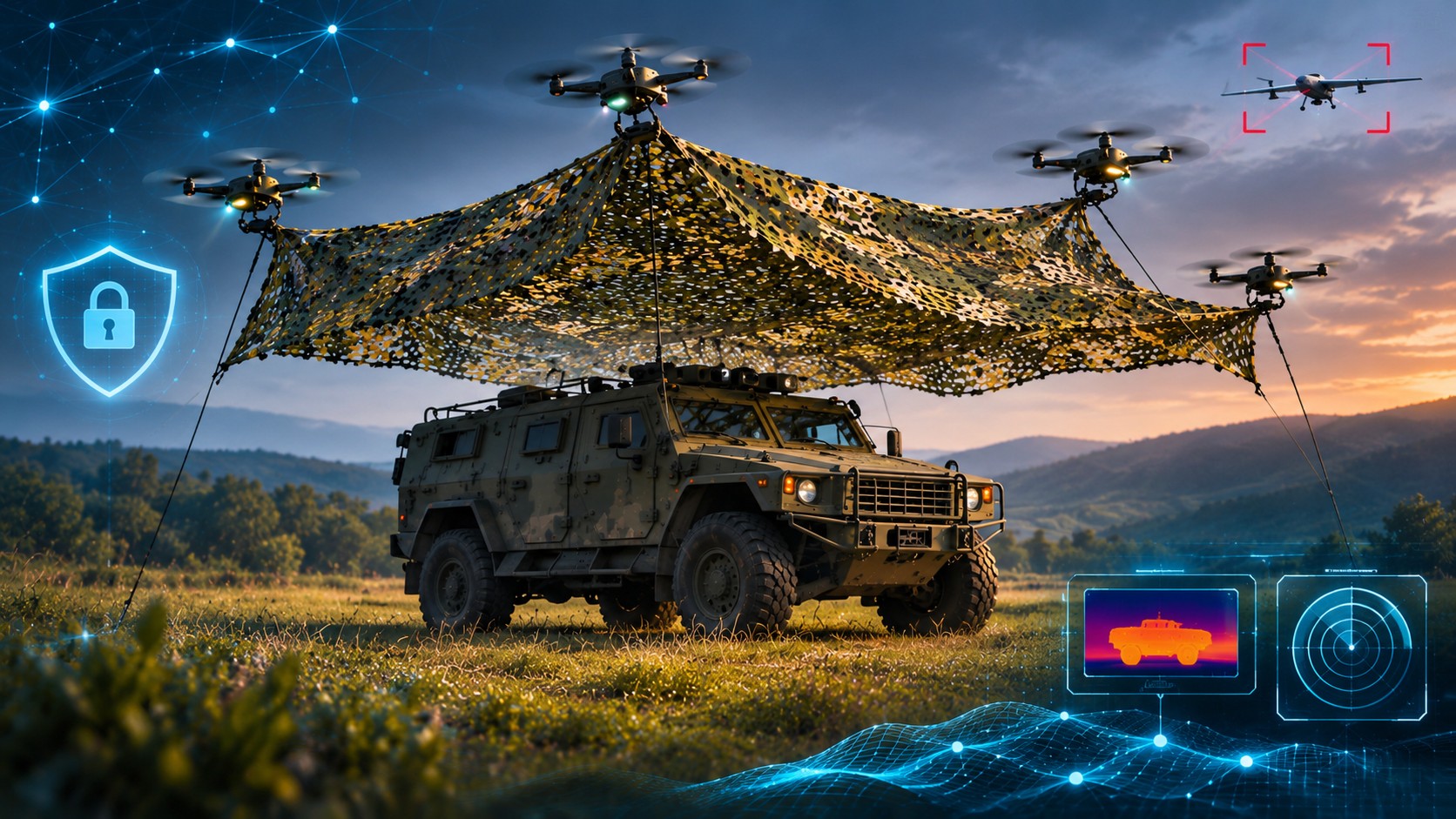
Symbolic illustration; AI-generated.
The Texas-based US American defense company Vigil Autonomy has unveiled Air Cover, a concept for an autonomous, airborne camouflage system. Designed to shield military vehicles, personnel, and equipment from reconnaissance drones, thermal imaging, and radar, the project was first announced in late October 2026 and gained widespread coverage across defense media in early November.
The setup relies on four unmanned lift modules that suspend a multispectral camouflage tarp - ranging from 4 to 100 square meters - up to 10 meters above the protected asset. The system runs on dedicated ISR Control software and features two operational modes: Stealth Mode, which minimizes thermal and radar signatures, and Decoy Mode, which projects a false signature away from the actual vehicle. What sets the design apart is how it pairs traditional concealment with autonomous drone tech, allowing the canopy to automatically adjust its position on the move without human intervention.
From a networking and cybersecurity perspective - looking at it through the Network+ lens - I see this setup essentially functioning as a mobile ad-hoc network (MANET) burdened by several critical vulnerabilities:
- Topology and Connectivity: Keeping four lift modules moving in sync requires a decentralized mesh network. Losing connection with - or simply losing - even a single node could trigger an immediate desynchronization, bringing the entire rig down.
- Latency and Jitter Sensitivity: Stabilizing a wide canopy while on the move demands telemetry exchanges down to the microsecond. Even minor lag or packet loss over the wireless link could destabilize the flight.
- Transmission Channel Vulnerabilities (OSI Layers 1–2): Both the drone modules and the central ISR Control unit depend entirely on the RF spectrum. Enemy electronic warfare - specifically jamming across the physical and data link layers - could completely isolate the drones from one another.
- Interception and Spoofing Risks (MitM): Without a physically secured perimeter, wireless links are prime targets for Man-in-the-Middle attacks, GPS/navigation spoofing, and injected rogue routing commands.
- RF Footprint and Electronic Exposure: Constant data exchanges and live video feeds for computer vision generate a continuous radio signature. Against modern signals intelligence (SIGINT), the system's own network traffic could give away a unit's position long before it is ever spotted visually.
Currently, Air Cover remains a publicly pitched concept, lacking any independent field testing under real combat or heavy electronic jamming conditions.
Sources:
Vigil Autonomy: Official Website
Vigil Autonomy: Air Cover Technical Overview
Vigil Autonomy: ISR Control Software Specifications
Defense WarRoom: Official Announcement (October 2026)
Army Recognition: Independent Concept Coverage (November 2026)
Defense Express: Capabilities and Architecture Analysis