
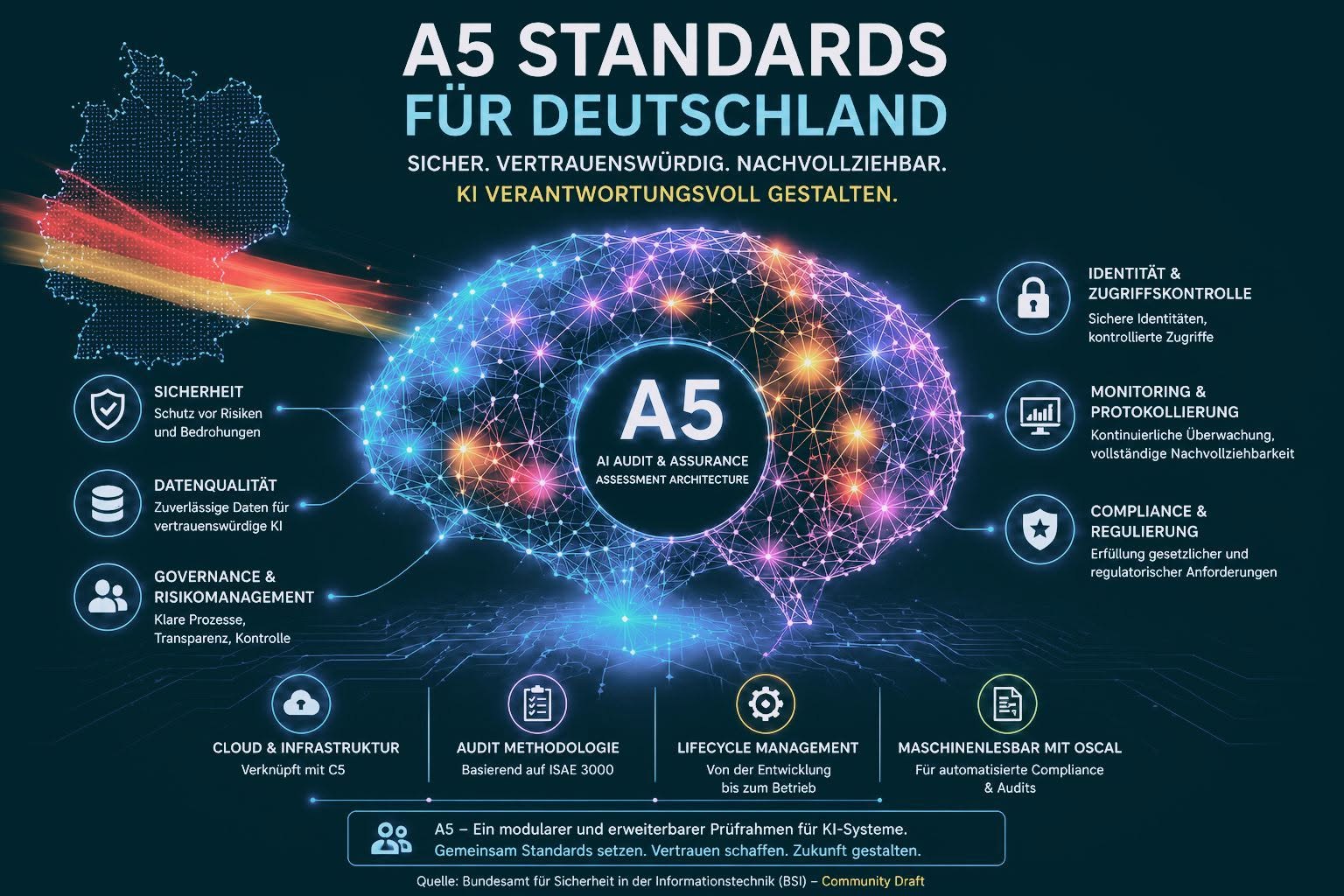
 The German Federal Office for Information Security (BSI) has published the AI Audit and Assurance Assessment Architecture (A5) as a Community Draft, introducing a new audit framework for AI systems.
A5 is designed to help organizations and public authorities systematically demonstrate the trustworthiness, security, and compliance of AI systems, particularly in light of the EU AI Act, the Cyber Resilience Act (CRA), and future regulatory requirements.
A particularly noteworthy aspect is that the assessment criteria are also published in the OSCAL (Open Security Controls Assessment Language) format. This enables organizations to automate compliance and audit processes more effectively and integrate the framework into existing GRC and security toolchains.
In my opinion, A5 has the potential to become for AI systems what C5 is for cloud services and ISO/IEC 27001 is for information security management.
Professionals who become familiar with this framework at an early stage will gain a valuable advantage in the rapidly evolving fields of AI Security, AI Governance, and AI Auditing.
For more information and to access the Community Draft, visit the official website: Federal Office for Information Security (BSI)

 This
This  Modern hybrid warfare no longer targets only infrastructure, territory, or military systems. Increasingly, it targets collective attention itself.